
"Healithic: A Patient-Controlled, Blockchain-Secured Electronic Medical Record System for Decentralized Healthcare in Bangladesh" by Jawad Zaman
Updated: 1 day ago
Healithic: A Patient-Controlled, Blockchain-Secured Electronic Medical Record System for Decentralized Healthcare in Bangladesh
Jawad Zaman, St. Joseph's University New York

Abstract
Modern healthcare systems, particularly in Bangladesh, face critical challenges including fragmented electronic medical records (EMRs), doctor shortages (7 per 10,000 people vs. WHO’s recommended 10–15), limited rural infrastructure impacting over 70% of the population, and data breach, privacy, and interoperability concerns. To address such systemic deficiencies, this study introduces Healithic, a patient-controlled digital health platform that uses blockchain technology to give individuals secure ownership and fine-grained control over medical records while streamlining clinical workflows. It employs a hybrid storage model to prioritize privacy and efficiency. Confidential health data is encrypted on the user’s device and stored securely off the blockchain in decentralized networks (IPFS) or HIPAA-compliant clouds. Patients authenticate using tamper-proof and permanently verifiable Web3 digital wallets, which enable password-free login and consent management. A distinguishing feature is the integrated telemedicine. Virtual appointment details are securely logged on-chain to ensure continuity and accountability in remote care. The platform also enhances healthcare delivery by leveraging AI-driven tools, including symptom checker chatbots and scheduling algorithms, to optimize doctor allocation and reduce waiting times. The developed functional prototype demonstrates secure record verification, dynamic access controls, and transparent audit trails aligned with GDPR and HIPAA standards. Healithic offers a scalable, equitable foundation for digital health in under-resourced settings by decentralizing data trust and centering patient control, with strong potential for global adaptation.
Keywords: Blockchain, Electronic medical records, Decentralized healthcare, Telemedicine
Introduction
The move to digital technology in healthcare has pushed the use of electronic medical records (EMRs). But contemporary EMR systems primarily serve institutional workflows rather than patient needs. They can be unclear and hard for patients to access, even though it is their information. Medical records often stay stuck in individual hospital systems (Alomar et al., 2024). This lack of shared information and patient control causes problems with care coordination, more paperwork, and worries about privacy and data access (Guo et al., 2023; Han et al., 2025).
Even with good digital health systems, patients usually do not get much say in who sees their data, how long they can see it, or what they can do with it. Current systems for confirming who you are depend on central places where data is kept, which can fail or be hacked (Javed et al., 2021). Checking features are basic or missing, so patients cannot easily see who looked at their records and why (Cocco & Tonelli, 2024). Because of this, there is a critical need for a patient-centric health data management framework that is safe and puts patients first.
Blockchain technology could fix these issues. It provides security and trust, along with ways to check records that cannot be changed. Its key parts, immutability, transparency, and cryptographic verifiability, make a base where patients can control their health information (Thantharate & Anurag, 2024; Stamatellis et al., 2020). Still, many ideas for using blockchain in health are just ideas or do not go far enough. They often just focus on proving something exists, without dealing with who can see it, getting permission, or fitting it into how clinics work.
This research focuses on two research questions: (RQ1) How can blockchain-based architecture enable patient-controlled access to electronic medical records while maintaining regulatory compliance (GDPR, HIPAA) in resource-constrained settings? (RQ2) What design patterns support seamless integration of telemedicine workflows with decentralized identity and auditability without compromising usability or performance?
This study introduces Healithic, a comprehensive, patient-controlled EMR platform built on blockchain technology. Unlike old systems, Healithic uses wallet-based methods to prove who you are, which eliminates password-based authentication in favor of cryptographic wallet signatures. Instead, it uses Web3 technology. Every action like adding a record, asking a provider to see it, or setting up a virtual meeting, is signed and saved on the blockchain. This makes sure you can track things and lets users control who can see their information.
One distinguishing feature about Healithic is how it mixes in telemedicine, applying blockchain trust to remote care. Patients can start virtual visits, verify appointments, and link clinical results to their records, all in one connected system. With this design, Healithic shows that a patient-run EMR system is not only possible but works well. The prototype has four basic pieces of digital health: checking who you are, proving records are correct, managing who can see records, and setting up clinical meetings. Using a mix of on-chain and off-chain models, Healithic balances speed with privacy while following rules like GDPR and HIPAA. By doing this, the platform makes a safe, clear, and patient-focused digital health area.
System Architecture & Design
The Healithic framework is a decentralized system for managing electronic medical records with a focus on giving patients more control over their data. It uses blockchain to help keep records secure and make sure access is tracked and cannot be changed later. Since storing everything on the blockchain would be too slow and expensive, the system only keeps important metadata on-chain, like hashes and access logs. The actual medical files, like PDFs or scan images, are stored off-chain after being encrypted. This way, the system stays fast and private but still allows anyone to check if a record has been tampered with. In this section, we will go over the main parts of the system, how data moves between them, the encryption used, and how smart contracts are used to manage who can see what.
High-Level Architecture
The architecture of Healithic is structured into four core layers: the User Interface (UI), the Application Logic (implemented as a decentralized application), the Smart Contract Layer, and the Data Storage Infrastructure. Additionally, a fifth component, the Telemedicine Coordination Layer, has been integrated to support end-to-end management of virtual care workflows, extending the system’s functionality beyond record management into clinical coordination. A conceptual architecture diagram is illustrated in Figure 3.1.
Figure-3.1
Architecture diagram

The decentralized app (DApp) is what the user sees and interacts with. It lets patients and providers log in using a crypto wallet, like MetaMask. When a user does something that changes the system, like uploading a record, giving access to a doctor, or setting up a telemedicine visit, that action is sent as a transaction. The user must sign it with their wallet. This makes sure no one else can do it for them. Once the transaction is confirmed on the blockchain, it cannot be changed or removed. Every action is saved on-chain as an event. These logs can be checked later by the patient or an auditor to see who did what and when.
On-Chain vs. Off-Chain Data Strategy
To optimize cost, performance, and regulatory compliance, Healithic employs a hybrid storage model:
On-chain: Only metadata and cryptographic commitments are stored on the blockchain. These include:
SHA-256 hashes of medical records.
Timestamps of record creation and access events.
Wallet addresses of patients and authorized providers.
Access control policies and revocation logs.
Appointment metadata (provider, time, consent status).
Off-chain: The actual medical files are stored outside the blockchain, after being protected:
Files such as PDFs, scan images, and clinical summaries are encrypted on the user’s device using AES-256.
Encryption happens before the file leaves the browser, so the raw data is never exposed.
Encrypted files are stored in either IPFS (a decentralized file system) or in HIPAA-compliant cloud storage, depending on the setup.
The blockchain only stores a link, like a CID (Content Identifier) or a secure URL; this points to where the file is located.
This way, authorized users can retrieve the file when needed, but the data itself remains private and off-chain. Only the minimum necessary information is put on the blockchain. This follows the principle of data minimization, which is required under GDPR (Article 5) and HIPAA’s Minimum Necessary Rule (Jurczuk & Suprunowicz, 2024).
Identity and Authentication: Wallet-Based Access
Healithic replaces conventional username-and-password authentication with a decentralized identity model based on Web3 wallet integration, such as MetaMask or similar Ethereum-compatible clients. During initial access, the user establishes their identity by connecting a personal wallet, which functions as a cryptographic anchor for all subsequent interactions. This approach eliminates reliance on centralized credential databases and leverages public-key cryptography to authenticate the user in a secure, non-repudiable manner. The wallet address acts as the unique patient identifier, enabling:
Non-repudiable transaction signing.
Decentralized authentication without centralized credential stores.
Seamless integration with blockchain-native access control mechanisms.
Smart Contract Subsystem
The core logic of Healithic is implemented through a suite of modular, interoperable smart contracts deployed on an Ethereum-compatible blockchain. Each contract enforces a specific domain function with deterministic, tamper-proof execution.
PatientRegistry: Maintains a mapping between wallet addresses and patient profiles. Supports identity verification and linkage to medical history.
AccessControl: Implements a revocable, time-bound permission system. Providers must be explicitly authorized by the patient to access records. Each grant generates an event logged on-chain, including provider address, scope of access, expiration timestamp, and consent signature.
RecordManager: Handles the lifecycle of medical records:
Receives a SHA-256 hash of the encrypted file.
Associates it with the patient ID and provider.
Logs the transaction with a timestamp and submitter address.
Emits a RecordAnchored event for external verification
This establishes data provenance and tamper-evident logging.
AppointmentLog: Extends the framework to telemedicine by anchoring appointment metadata (provider-patient pairing, scheduled time, consent status, and completion confirmation). Each event is signed by the initiating party, enabling non-repudiation and auditability of virtual care interactions.
Cryptographic Foundations: All records undergo a hash-then-anchor workflow:
The file is encrypted off-chain using AES-256.
SHA-256 hash of the encrypted file is computed.
The hash is submitted to the RecordManager contract.
The transaction is mined, permanently anchoring the hash.
Any future alteration to the file results in a hash mismatch, immediately detectable during verification. This provides cryptographic integrity without storing sensitive data on-chain.
Data Flow and Operational Workflow
The end-to-end data flow is as follows:
Upload: A provider uploads a medical record via the DApp.
Hash Generation: The system computes the SHA-256 hash of the encrypted file.
Off-Chain Storage: The encrypted file is stored in IPFS; the CID is returned.
On-Chain Anchoring: The hash, CID, patient ID, provider ID, and timestamp are submitted to the RecordManager contract.
Access Control: The patient is notified and may grant or deny access via wallet signature.
Audit Trail: All actions are emitted as blockchain events, forming a verifiable audit log.
Access Control Lifecycle
The access control process follows a four-stage lifecycle:
Grant: Patient authorizes provider via smart contract call.
Log: Event is recorded on-chain with metadata.
Revoke: Patient terminates access; contract updates permission status.
Audit: Third parties may query the blockchain to verify access history.
This lifecycle ensures continuous accountability and aligns with regulatory requirements for access monitoring.
Implementation
The Healithic system has been realized as a functional decentralized application (DApp) that exemplifies end-to-end patient control over electronic medical records, leveraging blockchain-anchored integrity checks and access policies enforced through smart contracts (Bautista et al., 2023; Kalita et al., 2024). The implementation follows established Web3 architectural principles, facilitating coherent interaction between the user interface, wallet-based identity layer, and blockchain backend (Buldas et al., 2022). Although the current deployment emphasizes accessibility and clarity for demonstration purposes, the system’s modular design ensures compatibility with Ethereum-compatible networks and decentralized storage solutions, allowing straightforward migration to a production-grade environment (Singh et al., 2025).
Frontend Architecture and User Interface
The frontend is built using lightweight, standards-compliant technologies, HTML5, CSS3, and ECMAScript 2015+ (ES6+), organized around a component-based structure inspired by React’s design philosophy. This approach supports modularity and long-term maintainability without requiring a full framework, keeping the client-side footprint minimal. The user interface emphasizes usability, visual clarity, and responsive design to ensure consistent functionality across desktop and mobile platforms.
The application follows the single-page application (SPA) model, where content is dynamically updated in response to user actions and changes in blockchain state. This enables a fluid user experience while maintaining alignment with the decentralized nature of the system. Core UI components include:
Wallet Connect Module
The Wallet Connect Module facilitates secure authentication via integration with Web3-enabled wallets such as MetaMask. Upon connection, the user’s wallet address is used to instantiate their identity, enabling cryptographic signing of transactions without exposing private keys.
Record Management Dashboard
The Record Management Dashboard displays a chronological list of anchored medical records, each annotated with a timestamp, provider, and a cryptographic hash. Users may verify the integrity of any record through blockchain lookup.
Access Control Panel
The Access Control Panel provides a real-time view of authorized entities, including healthcare providers and research institutions. Patients can grant or revoke access through signed transactions that update the AccessControl contract state.
File Upload Interface
The File Upload Interface enables providers to submit new records. Upon selection, the file is processed client-side to generate a SHA-256 hash, which is then submitted to the blockchain.
Telemedicine Scheduler
The Telemedicine Scheduler is a dedicated module for initiating and tracking virtual consultations. Appointment requests are structured as blockchain transactions, capturing provider, time, and consent status.
Client-Side Logic and Blockchain Interaction
User interactions that modify system state, such as granting access to a provider, submitting a medical record, or scheduling a telemedicine appointment, are implemented as blockchain transaction workflows. These operations are mediated through ethers.js, which handles communication with the smart contracts by abstracting low-level Ethereum JSON-RPC calls into manageable, high-level functions. This abstraction layer improves code maintainability and reduces the potential for client-side errors during transaction construction.
Wallet integration is facilitated via the Web3 Provider API, enabling the DApp to interact with the user’s wallet without ever accessing or storing private keys. When a state-changing action is initiated, the system prompts the user to sign the transaction through their wallet interface. This ensures that all modifications are explicitly authorized, preserving user agencies and aligning principles of decentralized identity and non-repudiation (U. S. Department of Commerce, 2014).
For example, when a patient revokes access, the DApp constructs a call to the revokeAccess (address provider) function in the AccessControl contract. The user approves the transaction in their wallet. The transaction is broadcast to the network, where it is mined and permanently recorded. The UI updates to reflect the new permission state. This flow ensures non-repudiation, auditability, and tamper resistance, core tenets of blockchain-based systems.
Data Handling and Security Measures
All sensitive medical files are encrypted on the client side using the Web Crypto API, employing the AES-256-GCM algorithm to ensure both confidentiality and integrity prior to transmission. This client-side encryption guarantees that plaintext data never leaves the user’s environment, even during upload. The resulting encrypted payload is stored in a decentralized file system, conceptually aligned with IPFS, and the corresponding content identifier (CID) is recorded in the blockchain transaction alongside the record hash.
Cryptographic hashing of the file, using SHA-256, is performed entirely within the browser, ensuring that the commitment to the data is generated before any network interaction occurs. By keeping sensitive processing local, the system enforces end-to-end privacy and adheres to zero-trust security principles, where no component, internal or external, is inherently trusted with unencrypted health data.
User Workflows
The system supports four primary user flows, each reflecting a critical healthcare interaction.
Patient Onboarding
Upon first access, the user connects their wallet and establishes their identity. No personal data is stored server-side; the wallet address serves as the unique identifier. The dashboard initializes based on the on-chain state associated with the address.
Provider Record Upload
Authorized providers upload clinical documents through a secure interface. The system generates a hash, stores the encrypted file off-chain, and submits the hash to the RecordManager contract. A transaction receipt confirms anchoring.
Consent Granting
Patients receive notifications of access requests. Approval triggers a signed transaction to the AccessControl contract, creating an immutable log of consent. The provider gains time-limited access, which may be revoked at any time.
Telemedicine Appointment Scheduling
Patients initiate virtual consultations by selecting an authorized provider and proposing a suitable time through the telemedicine interface. This appointment request is structured as a blockchain transaction and submitted to the AppointmentLog contract, which records the metadata, including participant identities and scheduled time, on-chain. This process creates a verifiable and tamper-evident record of intent, cryptographically timestamped and accessible for audit. Once the session concludes, the resulting consultation summary is encrypted, hashed, and anchored to the blockchain, linking it to the original appointment. This integration closes the loop between care coordination and documentation, establishing a continuous, auditable chain of clinical events.
Deployment and Execution Environment
The DApp is deployed as a static website using GitHub Pages, enabling globally accessible, censorship-resistant distribution without reliance on centralized servers. All application logic is executed client-side, in accordance with established best practices for decentralized applications, where trust is maintained through code transparency and cryptographic verification rather than backend authority. Although the current deployment operates without a live blockchain backend to facilitate demonstration and evaluation, the system’s architecture is natively compatible with Ethereum, Polygon, and other EVM-compatible networks. The smart contract interfaces and transaction workflows are designed to be seamlessly reconfigured for on-chain deployment, requiring only environment-level updates to the provider endpoint.
Security, Privacy & Compliance
Healithic’s security model follows a privacy-by-design approach: sensitive payloads never leave the user’s device unencrypted, while all control logic is executed by deterministic smart contracts resistant to tampering or insider abuse. This section details the technical safeguards and demonstrates alignment with GDPR and HIPAA.
Figure-4.1
Data-Protection Principles

Figure-4.2
Threat Model & Mitigations

Figure-4.3
Regulatory Mapping

Website Demonstration
A fully interactive prototype of the Healithic platform has been developed and is publicly accessible at: https://jzaman2004.github.io/Blockchain-Medical-Record/. The key user interface states are illustrated below with screenshots showing wallet connection, medical record dashboard, access control panel, file upload and verification, and telemedicine appointment scheduling.
Figure-5.1
Connecting Wallet

Figure-5.2
Accessing Medical Records

Figure-5.3
Granting Medical Record Access
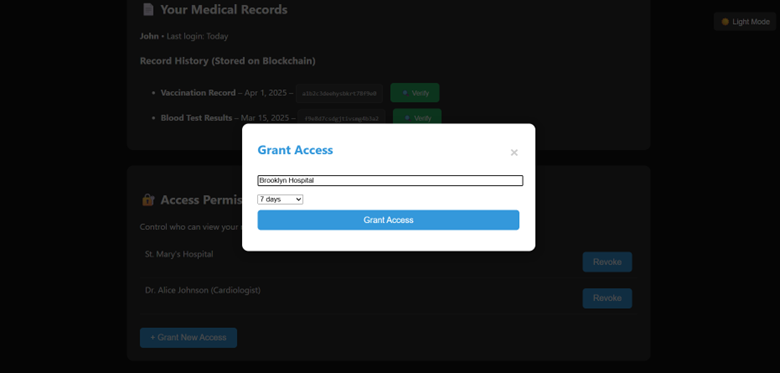
Figure-5.4
Uploading Documents via Blockchain

Figure-5.5
Scheduling Telemedicine Visit

Research Findings
This study shows that it is possible to enable patient-controlled EMR access in resource-constrained settings using blockchain architecture. Healithic implements cryptographic hashes, access policies, and audit logs on-chain, and stores encrypted medical files off-chain in decentralized or compliant cloud storage. It is able to achieve regulatory compliance with both GDPR Article 5 (data minimization) and HIPAA's Minimum Necessary Rule without sacrificing cryptographic integrity or patient agency (Mondschein & Monda, 2018; Herdman & Moses, 2006). Client-side encryption using the Web Crypto API (AES-256-GCM) ensures that health data never leaves the user's environment (Pradeep Kumar et al., 2024). On the other hand, smart contract-enforced access controls provide revocable, time-limited permissions that are transparently auditable on-chain. This hybrid approach proves that cryptographic design can bridge the gaps between regulatory compliance and patient sovereignty, even with limited infrastructure.
Healithic also uses a smart contract design for telemedicine integration. The AppointmentLog contract coordinates patient-provider interactions through client pairing, appointment time scheduling, consent sharing, and session completion. It uses a chain of clinical events that links virtual care to patient-controlled records (Singh et al., 2025). The system structures the telemedicine interactions as signed blockchain transactions, which ensures verifiability and confidentiality. The usability is preserved using a lightweight frontend abstraction that offers a framework to integrate decentralized trust mechanisms with remote care platforms without compromising accessibility or scalability.
Relevance to Bangladesh’s Digital Health Landscape
The healthcare system in Bangladesh struggles with underfunding, physician shortages, and out-of-pocket costs (Perry & Chowdhury, 2024). Although Bangladesh provides exceptional healthcare despite economic poverty, there are multiple barriers to implementing traditional medical record systems (Chowdhury et al., 2013). Bangladesh has approximately 7 doctors for every 10,000 people, which is significantly lower than the World Health Organization recommendations (Ahmed et al., 2011). The majority (70%) of the population lives in rural areas and has limited connectivity to support National Digital Health Platforms (NDHPs) (Akter & Kabir, 2023).
The Bangladesh Digital Health Strategy 2023–2027 and the a2i (Aspire to Innovate) program emphasize healthcare information system interoperability, personal electronic health records access, and telemedicine for achieving universal health coverage (Mamun & Kayenat, 2026; Chowdhury et al., 2025). Healithic aligns directly with these policy objectives because it operates independently without integrating into pre-existing hospital infrastructure. It uses a lightweight web-based interface that requires minimal infrastructure, while enabling patients to securely store, share, and audit their own records. The system aligns with the government’s vision of a decentralized health data ecosystem.
The telemedicine and access control features of Healithic address the challenges of workforce distribution by providing virtual consultations in areas where access to healthcare specialists is limited. Patients in rural areas can grant time-bound permission to remote providers without relying on centralized scheduling or record-keeping systems. The hybrid storage model further supports these communities by keeping only lightweight metadata on-chain and storing encrypted files locally or in decentralized networks. It reduces dependency on high-speed institutional connections.
Healithic is a very useful tool for the existing healthcare system in Bangladesh because it is not just practical, but also scalable without imposing costly infrastructure upgrades. By prioritizing low-resource compatibility and regulatory alignment, the system demonstrates how decentralized health technology can be adapted to national priorities in resource-constrained settings.
Limitations & Future Work
Deployment Infrastructure Constraints
The current Healithic prototype operates in a demonstration environment without a live mainnet deployment. So, it is difficult to understand transaction throughput, gas cost efficiency, and network resilience in a large-scale setting. The actual deployment costs and latency have not been stress-tested in production settings. Moreover, the system relies on public IPFS nodes for decentralized storage, which does not guarantee long-term data storage.
Digital Literacy Challenges
Although wallet-based authentication is cryptographically secure, it is difficult to use for non-technical patients. Rural Bangladesh lacks digital literacy in understanding transaction signing. 51.4% of Bangladeshi doctors still use paper-based methods for their medical record system (Bouh et al., 2024). Although the web-based frontend interface is user-friendly for anyone, it may cause challenges during onboarding and daily use.
Regulatory Recognition
Most countries in the world have laws like the GDPR or HIPAA principles that allow people to erase all their medical records if they wish to (Jurczuk & Suprunowicz, 2024). Even though Healithic aligns with GDPR and HIPAA principles, Bangladesh has no such law on medical regulatory certification and legal recognition of blockchain-based consent (Haq et al., 2025). Under the Bangladeshi legal regime, there are very few data protection laws and rights. So, implementation of this system might be legally complicated in underdeveloped countries.
Network Dependency
The hybrid storage model of Healithic requires an internet connection for blockchain interaction and encrypted file retrieval. When the signal drops, sending new information or running automatic checks can get stuck or fail temporarily (Islam et al., 2026). Remote areas of Bangladesh do not have reliable network connections. Healithic does help by saving a local copy of the data for viewing recent records. However, it can only send everything once the internet connection is strong enough. Therefore, the system is not ready for places where connectivity is unreliable.
Future Work
To address these limitations, future development will focus on three main areas. Firstly, the transaction costs for smart contracts need to be modified for high-volume clinical use. Secondly, a Bengali-language interface would reduce challenges for rural patients and community health workers. Thirdly, clinical pilot studies need to be conducted in partnership with local health centers to bridge the gaps of the current prototype.
Conclusion
Healithic redefines electronic medical records by establishing a patient-centric framework that uses blockchain technology to deliver sovereignty, security, and transparency over personal health data. By integrating wallet-based decentralized identity with modular smart contracts for granular access control, Healithic guarantees that every interaction is cryptographically signed, immutable, and auditable. This architecture directly addresses pressing challenges in Bangladesh’s healthcare system, including fragmented records, doctor shortages, and rural healthcare barriers, while simultaneously enhancing data integrity and trustworthiness (Islam & Fatema, 2025; Ahmed et al., 2011). The most distinguishing strengths of the platform are its tamper-proof on-chain anchored audit trails for verifiability, highly secure client-side encryption, and dynamic revocable consent-based real-time patient agency. Altogether, these reduce administrative burdens and unnecessary healthcare visits (Hossain et al., 2022; Bhuiyan et al., 2025; Raju & Glass, 2025). Acknowledging the scalability challenge of blockchain technology and regulatory adherence, pilot trials are recommended in rural Bangladeshi clinics, regulatory sandbox partnerships adapted to privacy legislation in other countries such as the GDPR's "right to erasure" (Esu, 2025), and the adoption of open standards that promote interoperability between decentralized health record systems (Seneviratne, 2023).
Lastly, Healithic converts static clinical reports into dynamic, patient-owned digital assets that embody healthcare justice and trust in the digital world. By equally weighing blockchain's immutable basis with practical AI extensions, it offers the foundation for an even more open, fair, and equitable global health landscape. Policymakers, health leaders, and technologists are invited to advance this vision of reaching a future where patients take control of their healthcare data and humankind is enriched safely by encrypted records (Kamal, 2025; Negash et al., 2024; Saqib, 2025; Hamiduzzaman et al., 2021).
Acknowledgments
The author acknowledges the early conceptual contributions of Abrar Galib Ohe, Mahatheer Hamid, Mumtahina Ambrin, and Danesh Rafin, whose initial collaborative efforts helped shape the foundational ideas of this project. No external funding supported this work.
References
Ahmed, S. M., Hossain, M. A., RajaChowdhury, A. M., & Bhuiya, A. U. (2011). The health workforce crisis in Bangladesh: Shortage, inappropriate skill-mix and inequitable distribution. Human Resources for Health, 9(1). https://doi.org/10.1186/1478-4491-9-3
Akter, M., & Kabir, H. (2023). Health inequalities in rural and urban Bangladesh: The implications of digital health. Mayo Clinic Proceedings: Digital Health, 1(2), 201-202. https://doi.org/10.1016/j.mcpdig.2023.04.003
Alomar, D., Almashmoum, M., Eleftheriou, I., Whelan, P., & Ainsworth, J. (2024). The impact of patient access to electronic health records on health care engagement: Systematic review. Journal of Medical Internet Research, 26, e56473. https://doi.org/10.2196/56473
Bautista, J. R., Harrell, D. T., Hanson, L., de Oliveira, E., Abdul-Moheeth, M., Meyer, E. T., & Khurshid, A. (2023). MediLinker: A blockchain-based decentralized health information management platform for patient-centric healthcare. Frontiers in Big Data, 6. https://doi.org/10.3389/fdata.2023.1146023
Bhuiyan, M. R. I., Husain, T., Islam, S., & Amin, A. (2025). Exploring the prospective influence of artificial intelligence on the health sector in Bangladesh: A study on awareness, perception and adoption. Health Education, 125(3), 279-297. https://doi.org/10.1108/he-10-2024-0125
Bouh, M. M., Hossain, F., Paul, P., Rahman, M. M., Islam, R., Nakashima, N., & Ahmed, A. (2024). The impact of limited access to digital health records on doctors and their willingness to adopt electronic health record systems. Digital Health, 10. https://doi.org/10.1177/20552076241281626
Buldas, A., Draheim, D., Gault, M., & Saarepera, M. (2022). Towards a Foundation of Web3. Communications in Computer and Information Science, 3-18. https://doi.org/10.1007/978-981-19-8069-5_1
Chowdhury, A. M. R., Bhuiya, A., Chowdhury, M. E., Rasheed, S., Hussain, Z., & Chen, L. C. (2013). The Bangladesh paradox: Exceptional health achievement despite economic poverty. The Lancet, 382(9906), 1734-1745. https://doi.org/10.1016/s0140-6736(13)62148-0
Chowdhury, M. H., Ripan, R. C., Islam, A. N., Hridhee, R. A., Sarker, F., Islam, S. M. S., & Mamun, K. A. (2025). Digital health inclusion towards achieving universal health coverage for Bangladesh utilizing general practitioner model. Health Policy and Technology, 14(4), 100731. https://doi.org/10.1016/j.hlpt.2023.100731
Cocco, L., & Tonelli, R. (2024). A self-sovereign identity–blockchain-based model proposal for deep digital transformation in the healthcare sector. Future Internet, 16(12), 473. https://doi.org/10.3390/fi16120473
Esu, R. (2025). Blockchain and data protection: Developing a functional erasure framework for storage limitation. Information & Communications Technology Law, 1-20. https://doi.org/10.1080/13600834.2025.2600197
Guo, H., Li, W., Nejad, M., & Shen, C.-C. (2023). A hybrid blockchain-edge architecture for electronic health record management with attribute-based cryptographic mechanisms. IEEE Transactions on Network and Service Management, 20(2), 1759-1774. https://doi.org/10.1109/tnsm.2022.3186006
Hamiduzzaman, M., De Bellis, A., Abigail, W., Kalaitzidis, E., & Harrington, A. (2021). The world is not mine – barriers to healthcare access for Bangladeshi rural elderly women. Journal of Cross-Cultural Gerontology, 36(1), 69-89. https://doi.org/10.1007/s10823-020-09420-w
Han, G., Ma, Y., Zhang, Z., & Wang, Y. (2025). A hybrid blockchain-based solution for secure sharing of electronic medical record data. PeerJ Computer Science, 11, e2653. https://doi.org/10.7717/peerj-cs.2653
Haq, M. Z., Ayub, Z. A. B., & Abdel Rahman, A. R. A. (2025). GDPR and Bangladesh's data privacy laws: A comprehensive analysis. International Journal of Public Law and Policy, 11(2), 192-209. https://doi.org/10.1504/ijplap.2025.145300
Herdman, R., & Moses, H. L. (2006). Effect of the HIPAA Privacy Rule on Health Research: Proceedings of a Workshop Presented to the National Cancer Policy Forum. National Academies Press.
Hossain, C. A., Mohamed, M. A., Zishan, M. S. R., Ahasan, R., & Sharun, S. M. (2022). Enhancing the security of e-health services in Bangladesh using blockchain technology. International Journal of Information Technology, 14(3), 1179-1185. https://doi.org/10.1007/s41870-021-00821-9
Islam, M. R., & Fatema, N. (2025). Healthcare challenges in rural Bangladesh. The Palgrave Handbook of Global Social Problems, 1-21. https://doi.org/10.1007/978-3-030-68127-2_844-1
Islam, R., Bose, R., Khan, A. A., Emara, A. M., Roy, S., Shaikh, Z. A., & Sutradhar, S. (2026). Blockchain-driven autonomous internet of auto in smart cities in India: A secure and intelligent framework for next-generation urban mobility. Energy Reports, 15, 109307. https://doi.org/10.1016/j.egyr.2026.109307
Javed, I. T., Alharbi, F., Bellaj, B., Margaria, T., Crespi, N., & Qureshi, K. N. (2021). Health-ID: A blockchain-based decentralized identity management for remote healthcare. Healthcare, 9(6), 712. https://doi.org/10.3390/healthcare9060712
Jurczuk, M., & Suprunowicz, M. (2024). Consent in data privacy: A general comparison of GDPR and HIPAA. Przegląd Prawniczy Uniwersytetu Im. Adam Mickiewicza, 16, 173-194. https://doi.org/10.14746/ppuam.2024.16.07
Kalita, K. P., Boro, D., & Kumar Bhattacharyya, D. (2024). Designing efficient patient‐centric smart contracts for healthcare ecosystems with access control capabilities. SECURITY AND PRIVACY, 7(6). https://doi.org/10.1002/spy2.427
Kamal, N. (2025). Telemedicine in Bangladesh: Transforming patient care in the digital age. Trends in Telemedicine & E-health, 5(5). https://doi.org/10.31031/tteh.2025.05.000625
Mamun, A. A., & Kayenat, M. S. A. (2026). Beyond the crisis: Forging a climate‐resilient health system for Bangladesh. Health Science Reports, 9(3). https://doi.org/10.1002/hsr2.72093
Mondschein, C. F., & Monda, C. (2018). The EU's General Data Protection Regulation (GDPR) in a research context. Fundamentals of Clinical Data Science, 55-71. https://doi.org/10.1007/978-3-319-99713-1_5
Negash, W. D., Belay, A. Y., Asmare, L., Geberu, D. M., Hagos, A., Jejaw, M., Demissie, K. A., Tiruneh, M. G., Abera, K. M., Tsega, Y., Endawkie, A., Worku, N., Workie, A. M., Yohannes, L., & Getnet, M. (2024). Barriers to healthcare access among reproductive age women in extremely high and very high maternal mortality countries: Multilevel mixed effect analysis. PLOS ONE, 19(9), e0304975. https://doi.org/10.1371/journal.pone.0304975
Perry, H. B., & Chowdhury, A. M. R. (2024). Bangladesh: 50 years of advances in health and challenges ahead. Global Health: Science and Practice, 12(1), e2300419. https://doi.org/10.9745/ghsp-d-23-00419
Pradeep Kumar, K., Prathap, B. R., Thiruthuvanathan, M. M., Murthy, H., & Jha Pillai, V. (2024). Secure approach to sharing digitized medical data in a cloud environment. Data Science and Management, 7(2), 108-118. https://doi.org/10.1016/j.dsm.2023.12.001
Raju, N., & Glass, M. (2025). Blockchain for secure and interoperable health data exchange. SSRN Electronic Journal. https://doi.org/10.2139/ssrn.5051662
Saqib, S. M. (2025). 14. Difference in healthcare access between Rohingya refugees and host community in Cox's Bazar, Bangladesh. European Journal of Public Health, 35(Supplement_6). https://doi.org/10.1093/eurpub/ckaf180.415
Seneviratne, O. (2023). Enabling data interoperability for decentralized, smart, and connected health applications. In CHASE '23: Proceedings of the 8th ACM/IEEE International Conference on Connected Health: Applications, Systems and Engineering Technologies. https://doi.org/10.1145/3580252.3589433
Singh, M. K., Kumar Pippal, S., & Sharma, V. (2025). A blockchain-ipfs framework for secure, scalable, and interoperable healthcare data management. SN Computer Science, 6(5). https://doi.org/10.1007/s42979-025-03936-z
Stamatellis, C., Papadopoulos, P., Pitropakis, N., Katsikas, S., & Buchanan, W. (2020). A privacy-preserving healthcare framework using Hyperledger Fabric. Sensors, 20(22), 6587. https://doi.org/10.3390/s20226587
Thantharate, P., & Anurag, T. (2024). MedBlock: Privacy-Preserving framework for next-generation electronic health records. Interdisciplinary Biotechnological Advances, 123-143. https://doi.org/10.1007/978-981-97-4268-4_6
U. S. Department of Commerce. (2014). Recommendation for block cipher modes of operation: : galois/counter mode (GCM) and GMAC. Eisenbrauens.


Comments